
CASE STUDY
Woodworking dust extraction system upgrade: Exceeding health and safety standards at an Auckland school
When an Auckland secondary school identified that its woodworking dust extraction system needed to work harder to protect staff and students, it engaged DUSTEX to design and deliver an upgrade - one that would need to meet a more stringent exposure standard than the current WorkSafe requirement, and be independently verified once complete.
DUSTEX is an Auckland-based industrial dust extraction and engineering specialist, designing, supplying, and commissioning NZ-made systems for clients across New Zealand since 2009.
Background
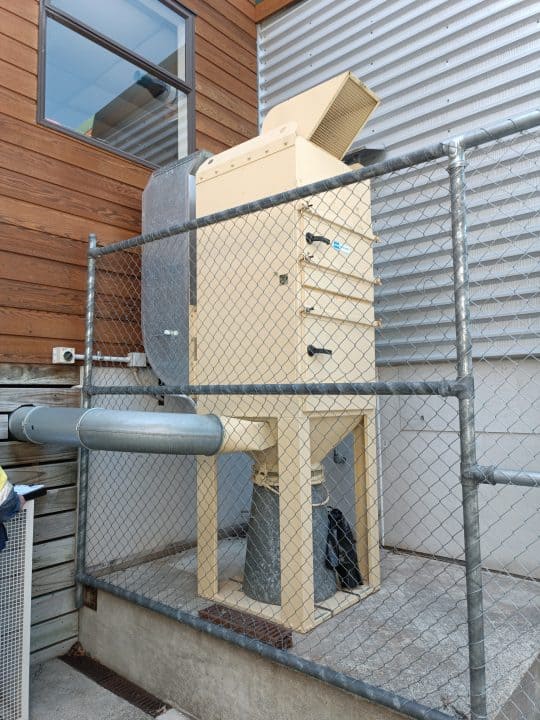
The Technology department of this Auckland secondary school operates a well-equipped woodworking workshop. The department runs a range of woodworking machines - including saws, sanders, and other dust-generating equipment - as part of its practical technology curriculum, and relied on a Local Exhaust Ventilation (LEV) system to capture and remove airborne wood dust at the source.
As a secondary school, it has a particular duty of care - staff work in the workshop across the full day, and students of varying experience levels use the equipment as part of their curriculum.
The problem
The school's Technology department operates multiple woodworking machines, all of which generate airborne wood dust as a by-product of normal use. Previous exposure monitoring had identified that improvements were needed to ensure that dust levels were being controlled more effectively. The school had set a demanding internal benchmark of 0.5 mg/m³ as an eight-hour time-weighted average (TWA) - a voluntary target twice as stringent as WorkSafe New Zealand's hardwood dust standard of 1 mg/m³ TWA, and four times tighter than the softwood dust limit of 2 mg/m³ TWA. It's a standard that reflects a serious commitment to staff and student wellbeing, well beyond minimum compliance.
Meeting that standard across a multi-machine workshop - where saws, sanders, and other equipment are running simultaneously - required a more capable woodworking dust extraction system than the existing setup could provide. The school engaged DUSTEX to carry out a full LEV upgrade.
The solution
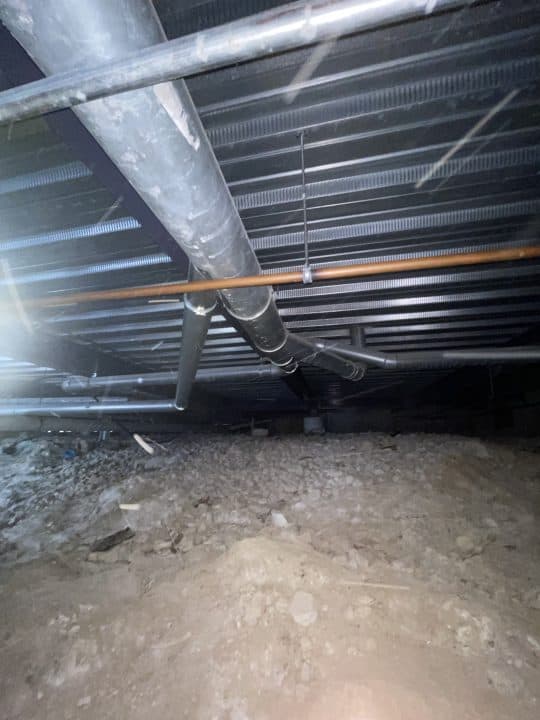
DUSTEX designed and installed a comprehensively upgraded woodworking dust extraction system for the school's Technology department. The approach was to address both the capacity of the system and the capture efficiency at individual machines - ensuring that dust was being extracted effectively at the point of generation, across every machine in the workshop. The scope of work included:
New dust collector and fan
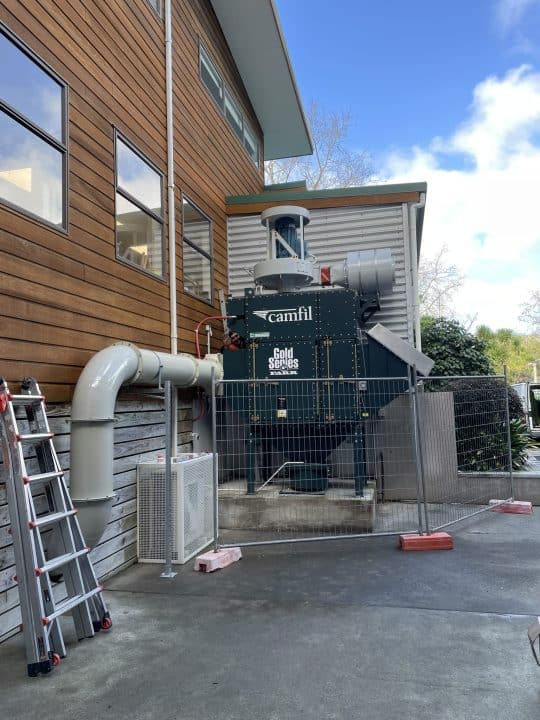
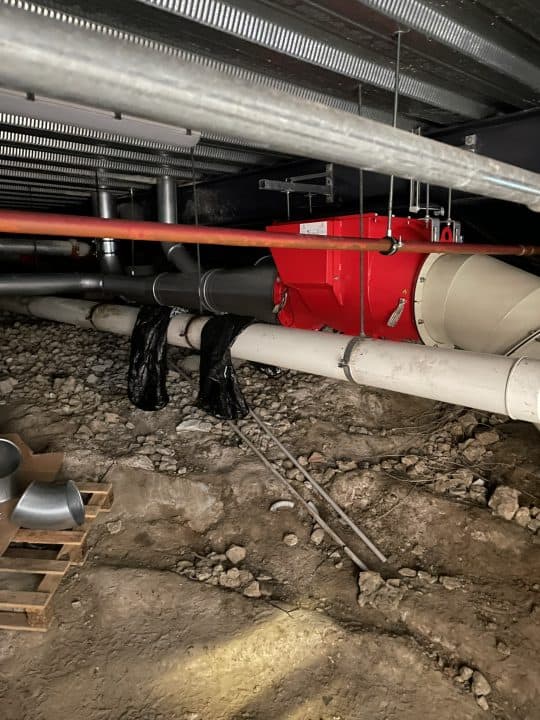
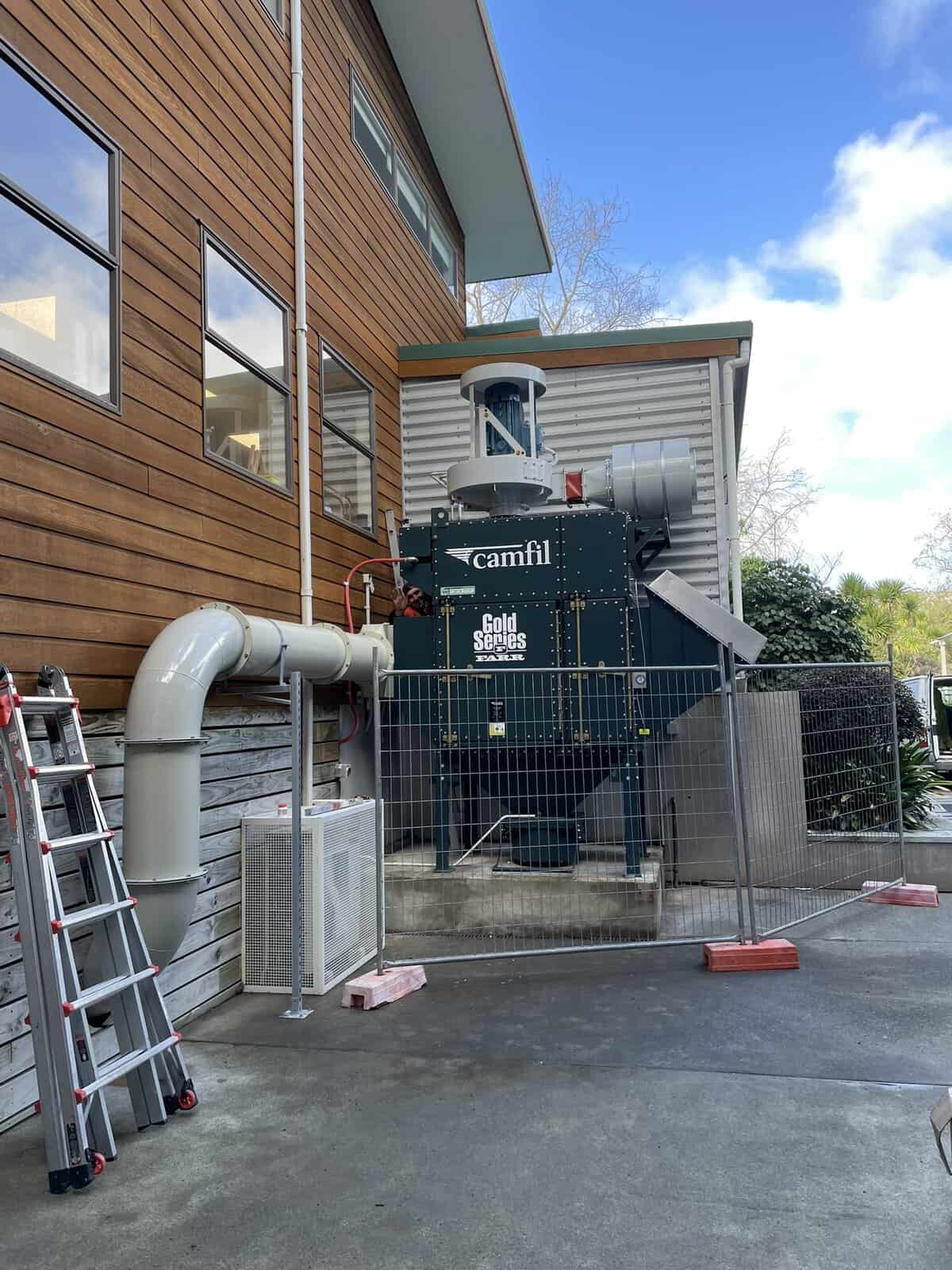
A new, correctly sized waste bin dust collector for woodworking and fan were supplied and installed. Together, they deliver the required airflow extraction across all machines in the workshop simultaneously. The new unit incorporated an explosion protection burst panel - an important safety feature in any woodworking environment, where fine dust in suspension can present an ignition risk. A ducted explosion protection isolation valve was also installed as part of the system.
New underfloor ducting
New dust extraction ducting was installed to replace the existing infrastructure, connecting the machines to the new collector and ensuring consistent airflow performance throughout the system.
Custom 3D-printed capture hoods
One of the most distinctive elements of the DUSTEX solution was the design and manufacture of custom 3D-printed capture hoods for several of the machines. Standard extraction hoods are functional but often inefficient - they can allow fugitive dust to escape at the edges, reducing capture effectiveness without necessarily being incorrectly sized or positioned.
DUSTEX applied dust extraction design theory to develop hoods that address these inefficiencies directly. The custom hoods feature an increased width to improve dust capture coverage, a larger extraction spigot diameter to reduce pressure loss in the airstream, and an optimised spigot angle to improve extraction efficiency at the point of generation. The result is a hood that draws more of the dust into the extraction system rather than allowing it to escape into the workshop air.
Machine-specific extraction improvements
In addition to the new collector, ducting, and custom hoods, DUSTEX carried out targeted improvements to the extraction enclosures on specific machines to maximise capture efficiency:
- Drop saw: Clear plastic sheeting was fitted across the front face of the enclosure to close off the opening, increasing the extraction efficiency of the hood and preventing fugitive dust from escaping into the workshop.
- Band saw: Seals were installed to close up open edges on the machine enclosure, reducing the pathways through which dust could escape and improving the overall capture rate.
Repurposing the existing dust collector
Rather than decommissioning the original dust collector entirely, DUSTEX repurposed it for use in a smaller classroom where it could adequately serve a reduced number of machines - extending the useful life of the existing equipment and avoiding unnecessary waste.
The results
The upgraded woodworking dust extraction system delivered exactly what the school set out to achieve: a workshop environment where wood dust exposure is controlled to the school's own voluntary standard of 0.5 mg/m³ TWA - twice as stringent as WorkSafe's hardwood dust limit, and four times tighter than the softwood standard.
Following completion of the installation, Air Matters - an independent occupational hygiene and air quality consultancy - was engaged as a requirement of the contract. Air Matters conducted full-shift personal exposure monitoring, including inhalable wood dust sampling. The monitoring confirmed that the upgraded system successfully met the school's hardwood dust exposure target across the workshop.
The custom 3D-printed capture hoods demonstrated that effective dust extraction isn't always about replacing equipment: sometimes it's about designing the right solution for the specific machine and the way it's used. The repurposing of the existing collector to a smaller classroom also ensured that every part of the Technology department's woodworking facility benefits from appropriate extraction, without unnecessary cost or waste.
For any organisation considering a similar approach - setting a voluntary exposure target more stringent than the WorkSafe minimum - this project demonstrates that it's an achievable goal with the right engineering solution and independent verification.
Frequently asked questions
What is a Local Exhaust Ventilation (LEV) system in a woodworking workshop?
A Local Exhaust Ventilation (LEV) system captures airborne dust at the point where it's generated - typically at each woodworking machine - and extracts it through a ducted network to a central dust collector. It's the recognised engineering control for wood dust exposure in workshop environments, and is more effective than relying on general ventilation or respiratory protective equipment alone.
What is the WorkSafe New Zealand standard for wood dust exposure?
WorkSafe New Zealand sets a maximum exposure standard of 2 mg/m³ TWA for softwood dust, and 1 mg/m³ TWA for hardwood dust - reflecting the greater health risk associated with hardwood species. Some organisations set their own internal targets that are more stringent than these minimums. The school in this case study voluntarily adopted a target of 0.5 mg/m³ TWA - twice as protective as the WorkSafe hardwood standard - as part of its commitment to staff and student health.
How do you verify that a woodworking dust extraction system is performing effectively?
The most reliable method is independent personal exposure monitoring, carried out by a qualified occupational hygienist. Full-shift monitoring measures the actual dust concentration in the breathing zone of the person using each machine, and compares it against the relevant exposure standard. This gives a real-world picture of system performance that airflow measurements alone can't provide, and is the approach recommended for any organisation that needs to demonstrate compliance with WorkSafe exposure standards.
Can 3D-printed components be used in a dust extraction system?
Yes - and in some applications, they're the best option. Standard extraction hoods are designed to fit common machine types, but they're often a compromise: they may allow fugitive dust to escape at the edges, or create unnecessary pressure loss in the airstream. A custom 3D-printed hood can be designed to the specific geometry of the machine, optimising both capture efficiency and airflow performance in ways that an off-the-shelf hood can't match.
Can a workplace set its own dust exposure standard more stringently than the WorkSafe limit?
Yes. WorkSafe New Zealand's exposure standards are minimum requirements, not recommended targets. Organisations can - and some do - set their own voluntary internal targets that are tighter, particularly where vulnerable groups such as students are involved, or where a precautionary approach to long-term health is a priority. Independent personal exposure monitoring is the most reliable way to verify whether a self-imposed standard is being met.
In the Media
The DUSTEX engineer
Perry Mundell
Director & Senior Design Engineer
BBA (UNISA) | DipPM (Damelin) | DipChem (Intec College)
Perry has been working in dust extraction and air pollution control since 1997, and managing engineering and capital projects since 1995 - experience that spans both the technical and commercial sides of complex industrial projects.
His career began at Mikropul, where he spent almost seven years managing turnkey engineering projects, before moving into project engineering roles at McAlpine Hussmann and Filtercorp covering ventilation, air conditioning, and dust extraction and air pollution control systems. He progressed to Engineering Manager at Filtercorp before joining DUSTEX as co-director in 2015. His experience with larger engineering firms gives him the capability to manage both large industrial projects and smaller, specialised ventilation systems.
At DUSTEX, Perry co-leads the business alongside Ken Skinner, with hands-on involvement across system design, industrial fan selection, project management, and commissioning.
Perry led the design and delivery of this woodworking dust extraction system upgrade, bringing his expertise in LEV system design, industrial fan selection, and project management to a project that required both engineering precision and close collaboration with the school and its independent hygienist. His goal, as always, was a solution that is practical, reliable, and straightforward for the people who use it every day - in this case, the staff and students working in the workshop.
Learn more about DUSTEX and meet the rest of the team.