
CASE STUDY
Breathing new life into a historic landmark: wood dust extraction for the Percy Vos Boat Shed
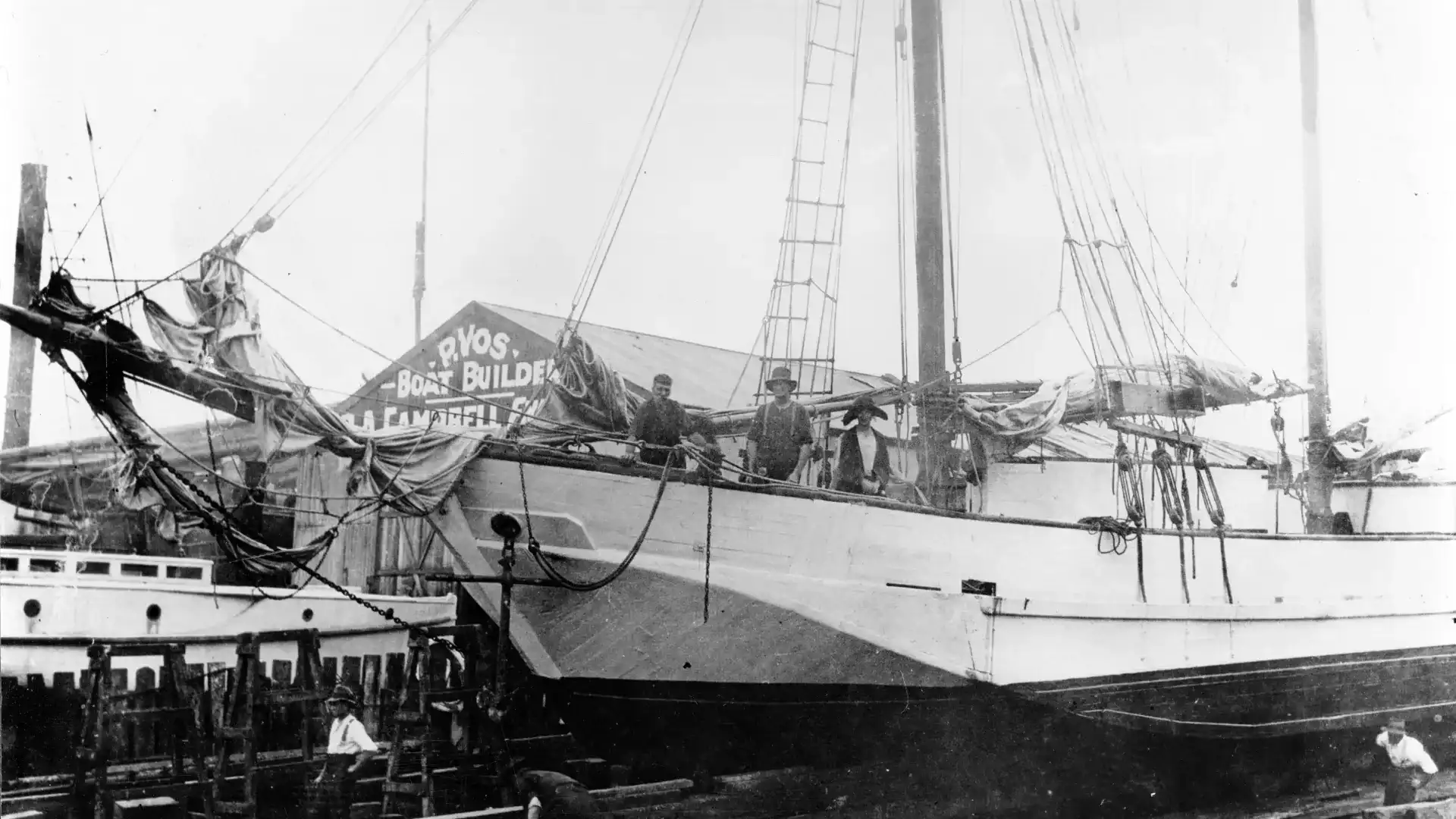
When New Zealand’s oldest surviving wooden boat shed was restored as a working boat-building facility, its new wood dust extraction system had to be reliable, efficient — and worthy of the heritage it was protecting.
DUSTEX is an Auckland-based industrial dust extraction specialist, designing and supplying NZ-made systems for heritage, commercial and industrial clients across New Zealand since 2009.
Background
The Percy Vos Boat Shed holds a unique place in New Zealand’s maritime heritage. Founded in 1922 by Percy Vos — a World War I veteran and master boat builder — the yard at 37 Hamer Street, Westhaven, became one of Auckland’s most respected boatbuilding businesses. Over seven decades, P. Vos Ltd built clinker dinghies, runabouts, fishing boats and even support craft for the United States Navy during World War II.
The yard closed its doors in 1994 and sat idle for around a decade before an extensive restoration brought it back to life as an events venue. In 2025, under the care of the New Zealand Maritime Museum Hui Te Ananui a Tangaroa, the shed underwent a further renovation — this time to restore it as a fully functioning wooden boat-building facility.
It is the oldest surviving wooden boat shed and slipway in New Zealand — and it needed a wood dust extraction solution to match its heritage.
The problem
Returning the Percy Vos Boat Shed to active use as a boat-building workshop meant addressing a practical challenge that hadn’t existed when it was an events venue: wood dust.
Timber and joinery workshops typically rely on small, individual dust collectors — portable units positioned next to each machine. While convenient, these units have real limitations:
- Fine wood dust passes straight through the filters, escaping back into the working environment.
- They take up valuable floor space in an already compact workshop.
- Each machine requires its own unit, creating a cluttered, difficult-to-manage setup.
For a heritage building being returned to productive use, neither the dust exposure nor the floor-space trade-off was acceptable. A more effective, centralised solution was needed.
Why a centralised wood dust extraction system?
DUSTEX recommended a centralised dust extraction system with the dust collector located outside the building, connected to the workshop machinery via a ducted network. This approach offered clear advantages over individual collectors:
- Far superior wood dust extraction — fine particles are captured efficiently, with a secondary filter to capture residual fines.
- The workshop floor remains clear — no collector units competing for space with boats under construction.
- A single, well-designed system is easier and more cost-effective to maintain than multiple independent units.
- All the noise and dust are kept outside the building, preserving the working environment inside.
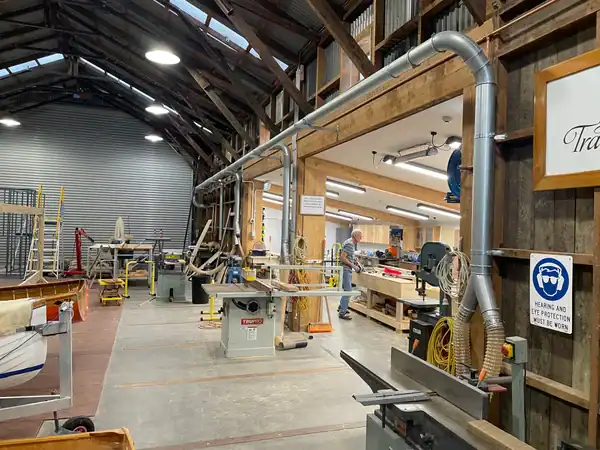
Every DUSTEX installation is custom-designed to suit the specific space and machinery involved, and the Percy Vos job was no exception. The ducting layout was planned around the workshop’s configuration, and the system was designed and manufactured locally in New Zealand.
The solution
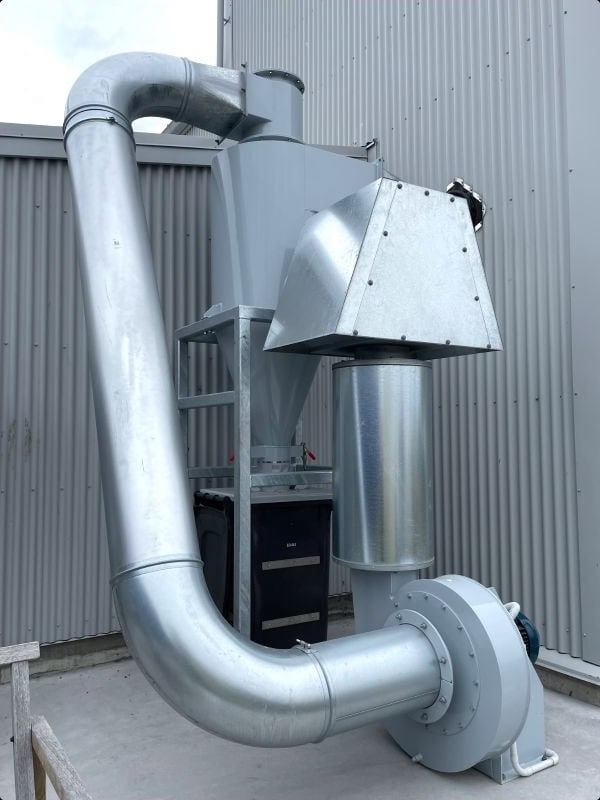
DUSTEX designed and supplied a centralised cyclone dust extraction system for the Percy Vos Boat Shed, comprising:
- A cyclone separator as the primary collection stage, efficiently capturing the bulk of wood waste and chips.
- An industrial fan to drive airflow through the ducted network.
- An acoustic silencer to manage noise.
- A secondary fine-dust filter to capture the residual particulate that passes through the cyclone stage.
- A ducting network running from each machine connection point to the external unit.
The collector is positioned outside the building, keeping the workshop floor clear and the working environment clean. The wood dust extraction system was designed and manufactured by DUSTEX in New Zealand.
The results
With the new centralised wood dust extraction system in place, the Percy Vos Boat Shed workshop operates with significantly cleaner air than would have been possible with the individual collectors typically used in joinery shops.
- Fine wood dust is captured before it can recirculate into the breathing zone of boat builders.
- The workshop floor is clear of portable collector units, giving craftspeople more room to work.
- A single external system is simpler to service and maintain than multiple individual units.
- The heritage fabric of the building is protected from the long-term effects of fine dust accumulation.
What does the client say?
“Our team really appreciated the ongoing support”
“Having gone to the market for advice and price comparisons, we ended up with DUSTEX. Ken and his team had spent the time listening to our vessel's staff and understood the scope requirements of this unique, historic landmark boat shed in the heart of the Auckland Viaduct. The design and components of the dust extractor needed to be in keeping with the historic look of the Percy Vos Boat Shed without compromising the performance of the dust extraction, which we believe was achieved.
“Our team really appreciated that after installation, the ongoing support and adjustments carried out by DUSTEX got the extractor working at maximum efficiency. I would not hesitate in recommending Ken and his professional team at DUSTEX.”
— Rod Vickers, Head of Operations, New Zealand Maritime Museum, Auckland NZ
Frequently asked questions
What type of dust extraction is best for a woodworking workshop?
A centralised cyclone system is the most effective option. It connects all machines via ducting to a single external unit, capturing coarse wood waste in the cyclone stage and fine dust in a secondary filter — keeping the workshop floor clear and the air genuinely clean.
Can a dust extraction system be installed in a heritage building?
Yes. The dust collector is located outside the building, protecting the heritage fabric from noise, vibration and dust. Ducting is routed internally to connect each machine, and the system is custom-designed around the building’s layout and constraints — as with the Percy Vos Boat Shed.
How does a cyclone dust extractor work?
Dust-laden air enters a spinning chamber; centrifugal force flings heavier particles outward and into a collection bin, while cleaner air passes to a secondary filter that captures fine residual dust. The two-stage process is efficient and low-maintenance because the cyclone removes the bulk of the load before it reaches the filter bags.
In the Media
The DUSTEX engineer
Ken Skinner
Director & Senior Design Engineer
NZCE (Mechanical), Auckland Technical Institute (now AUT)
Ken has been working in mechanical engineering since 1975, when he began his career as a draughtsman with the New Zealand Post Office. He went on to manage engineering projects for ABB Fläkt NZ — completing paint-finishing systems for Mitsubishi, Honda and Toyota, and industrial drying systems for the pulp and paper industry — before spending 16 years as Engineering Manager at Filtercorp International, overseeing filtration and dust-collection design, project management and R&D.
He founded DUSTEX in 2009 and acquired Industrial and Commercial Fans Limited in 2015, giving DUSTEX end-to-end capability across dust extraction, filtration and industrial fan selection and supply. He has direct expertise in timber and joinery dust extraction systems, having designed and supplied solutions for woodworking operations throughout New Zealand.
Learn more about DUSTEX and meet the rest of the team.